How to open a laundry in 2027: costs, steps, hidden traps
How to open a laundry in 2027: pick a model, price it with real quotes, check the building, size your machines and avoid the traps most owners meet.
To open a laundry in 2027, pick a business model first (self-service, pickup and delivery, or a production plant), then price it with written quotes, check the building before you sign, size your machines to your daily kilos, and open in one area. Published US guides put a laundromat at about $200,000 to $500,000, a delivery laundry at $10,000 to $50,000, and a home service at $2,000 to $10,000. In Spain, Electrolux estimates a self-service shop at €30,000 to €80,000.
I am Talal Junaid. I run a pickup-and-delivery laundry in Barcelona and I built LaundryFuture, laundry software, from what we use ourselves. This guide covers the steps in order and the traps that nobody mentions in the equipment catalogues. The idea is simple: learn from someone who already did it, rather than from mistakes that cost you money.
What type of laundry should I open?
Choose by how much money you have, how much risk you accept, and whether you want walk-in or delivery customers. Each model has a different cost, a different team and a different way of finding customers.
| Model | Start-up cost (published guide) | What you need | Main risk |
|---|---|---|---|
| Home-based wash and fold | $2,000 to $10,000 | Machines, supplies, insurance | Space and local rules |
| Pickup and delivery with a partner laundry | $10,000 to $50,000 | Vehicle, software, a partner plant | Depending on a supplier |
| Pickup and delivery with your own plant | More than the line above; depends on machines, site and power | Plant, staff, vehicles | Fixed costs before volume |
| Self-service laundromat | $200,000 to $500,000 or more | Lease, build-out, many machines | Heavy upfront capital |
US ranges come from Routific's guide. For Spain, Electrolux Professional estimates €30,000 to €80,000 to set up a self-service shop. These are vendor and guide figures, not quotes. Treat them as a sanity check and replace them with written quotes. The cost breakdown article explains why sources disagree.
Which model fits depends on your city and your money. A delivery model can serve a wide area from one plant, while a shop lives or dies on its street.

How do I work out my numbers before I spend anything?
Write down your monthly costs and the profit one order leaves. Break-even is the number of orders per month where profit per order, times orders, covers your fixed costs. If you cannot fill in the profit per order, you are guessing.
Use these lines:
- Premises: deposit, rent, fit-out, power, water and drainage work.
- Machines: washers, dryers, ironers, tables, carts, shelves.
- Vehicles: purchase or lease, insurance, fuel or charging.
- Licences and permits: fees and the time they take.
- Software: booking, point of sale, driver tool, customer records.
- Supplies: chemicals, hangers, covers, bags. See what supplies a laundry needs.
- People: wages for every hour you are open, including yours.
- Cash buffer: three months of rent and wages, at least.
Test your prices against your cost per order before you sign anything. If the plan only works at a volume you cannot reach in the first year, change the plan, not the spreadsheet.
How do I choose and check a location?
Check the building before you sign the lease. A laundry is a small factory: it needs power, water, drainage and a way to extract hot, humid air. Many owners find out too late that the site cannot carry the machines they planned.
Ask an engineer to check these before you sign:
- Power at the meter. Ask what the building can supply today, what a power increase costs and how long the utility takes to deliver it. Electric heating is the big load: see the figure under gas, electric or heat pump below.
- Water flow, not only water. A machine needs the right pressure and flow to fill fast. A single 14 kg professional washer needs two inlets at 200 to 600 kPa and a 75 mm drain. If the street supply is weak, you may need buffer tanks.
- Drains. Pipes that are too small cannot empty a washer quickly. That slows every cycle.
- Extraction. Dryers and ironers push out hot, moist air. Ask for the exact route of the duct, its diameter and where it exits. A single shared duct is a single point of failure for the whole plant.
- Loading. Where does the van stop? Can you carry bags in without blocking the street?
- Neighbours. Noise and smell become your problem on day one.
If you plan walk-in customers, add foot traffic and parking. If you plan delivery only, a plant in a cheaper industrial area can work better than a shop on a main street.
What licences does a laundry need?
Licences depend on your country and city, and on whether you use solvents. Check with your local authority before you sign a lease, because the permitted use of the premises can decide whether the site works at all.
Examples show how much it varies:
- England: a launderette is a "sui generis" use under planning law, so changing a unit to or from laundry use needs planning permission.
- Spain: solvent dry cleaning falls under the VOC rules in Royal Decree 117/2003, run by each region.
- Dubai: the municipality's technical guidelines for laundry facilities (version 5, March 2026) cover points such as pest control, eyewash where chemicals are handled and storage at least 20 cm off the floor.
- Saudi Arabia: a Balady licence is applied for online, with an exterior photo showing the sign, the lease or deed and the commercial registration.
For the UAE, Saudi Arabia and the UK, see the laundry licence guide. Rules change, so read the authority's page, not a blog, for the final word.
How do I choose machines?
Size your machines to the kilos you expect to process per day, not to the budget or the catalogue. Then check the dryers, because drying is usually the bottleneck. The laundry supplies list covers the full kit.
How many washers and dryers do I need?
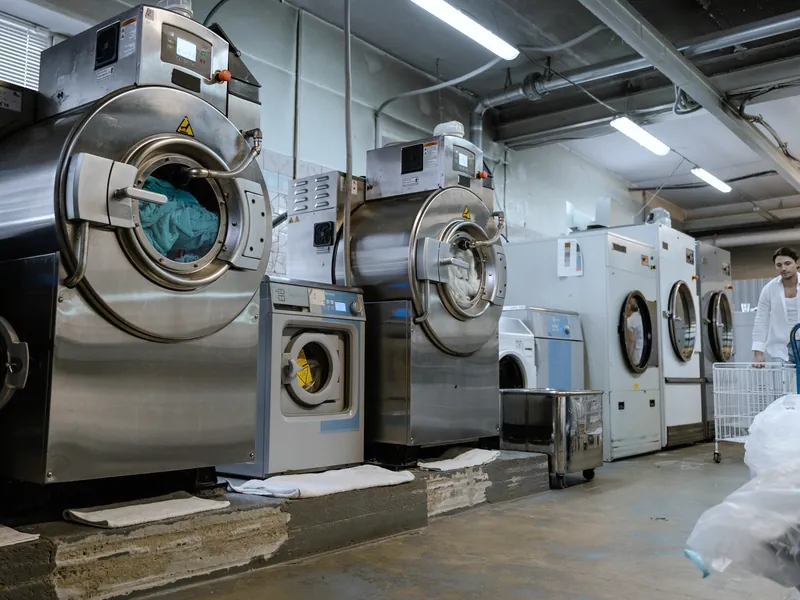
Work backwards from daily kilos. Divide the kilos you expect on a busy day by the kilos per cycle, then by the cycles per machine per day. A professional 14 kg machine on a 60 °C eco programme runs about 60 minutes per cycle, and loading and unloading add time. Trade guidance from Alliance Laundry Systems says to keep at least 1 to 1.1 of drying capacity for each unit of washing capacity. Adding washers without dryers, in Girbau's words, would certainly be a mistake.
Why does spin speed change your drying bill?
Every litre of water left in the load must be evaporated by the dryer. A washer with a higher G-force spins out more water. One 14 kg professional model reaches a G-factor of 450 and leaves 45 percent residual moisture. Soft-mount washers reach higher G-forces and cost more upfront. One distributor says about 25 to 35 percent more, and a rigid-mount maker argues that inverter drives bring rigid machines up to 300 G. Both are vendor claims. Ask each seller for the residual moisture of the model you are buying.
Gas, electric or heat pump?
Gas heat is cheaper per kWh than electricity in the EU. In the second half of 2025, EU business gas averaged €6.05 per 100 kWh and electricity €18.37 per 100 kWh, about three times as much (my division of the two figures). Gas also cuts the electrical load you must contract: the single 14 kg washer above has a 13 kW electric heater. Heat-pump dryers use less energy and need no exhaust duct. Electrolux claims savings of up to 65 percent against a vented dryer (a vendor claim), but each load takes longer.
New or second-hand?
New machines carry a warranty. Second-hand machines cost less, but if you buy them "as seen" you usually have no warranty, and ownership may pass only when you have paid in full. Read the contract before you sign, and have an engineer see the machines running. Indicative new prices: a dealer price list shows 14 kg rigid-mount washers at about €6,415 to €6,485 and 18 kg at about €7,290 to €7,385 (undated; ask for current quotes).
Which solvents and dry-cleaning machines are safe to buy?
If you plan dry cleaning, check the solvent rules for your country and building before you buy a machine. Rules are tightening in several places.
- France: perchloroethylene machines were phased out of premises near housing, with a total ban from 1 January 2022.
- United States: an EPA rule bans all PCE dry-cleaning uses after 19 December 2034, and no PCE in machines acquired after 16 June 2025.
- European Union: the industry body says PER is not banned in any EU country but member states restrict it. A public-health review calls professional wet cleaning the safest current alternative.
A solvent machine you cannot use is money you cannot recover. If most of your work is wash and fold, you may not need one at all.
What changes for laundries in 2027?
Energy is the main change to watch. The EU agreed to delay ETS2, a carbon price on fuel for buildings and transport that would hit gas dryers and boilers, by one year to 2028. Sources disagree on whether allowance auctions start in 2027 or 2028. Plan for gas prices that can rise, and ask each machine seller for the energy use per kilo.
Customers also expect more. They want to book on a phone, see when you will arrive and pay without calling you. If your current laundry software cannot do that, price a replacement such as LaundryFuture into your plan from the start.
How do I get my first customers?
Open with one zone, one price list and a small offer. Do not buy ads until you can track a paid order back to its source. See how to get your first laundry customers for a 30-day plan.
Three rules from our own laundry:
- Measure paid orders, not clicks, installs or map taps.
- Keep the same prices in the shop, on the site and in ads.
- Move first-time customers to your app, where repeat orders happen.
If you deliver, plan stops with care. A Belgian study found cargo bikes completed a median 18.85 deliveries an hour against 14.77 for vans. Dense zones make delivery pay. Far zones often do not.
What does nobody tell you about opening a laundry?
These are the points I wish someone had told me:
- The building decides everything. Power, water, drains and extraction can limit your capacity before you wash a single sock.
- Drying is the bottleneck. When dryers stop, the whole plant stops.
- One machine or one duct can stop the business. Keep a partner laundry on standby for overflow.
- Second-hand is cheap until it breaks. Check warranty and ownership terms.
- Cash runs out before profit arrives. Keep a buffer for the first months.
- Most customers order once. Repeat orders are what make the business work, so plan for them from day one.
- Run old and new systems in parallel. Never switch off the old till or software before the new one matches it.
- Run out of detergent and you stop. Keep two weeks of stock and a second supplier.
The full list of costly errors is in 10 mistakes laundry owners make.
FAQ
How much does it cost to open a laundry?
Published US guides give about $200,000 to $500,000 for a laundromat, $10,000 to $50,000 for a pickup-and-delivery service and $2,000 to $10,000 for a home service. In Spain, Electrolux estimates €30,000 to €80,000 for a self-service shop. Your own number depends on your site, machines and country, so get written quotes.
What do I need to open a laundry?
You need a business model, a site that can carry the power, water, drainage and extraction, the right licences, machines sized to your daily kilos, supplies, software for orders and payments, and cash for the first months.
How long does it take to open a laundry?
It depends on your licences, fit-out and machine delivery. I have no reliable general figure, so I will not invent one. Ask your local authority and your machine dealer for their lead times in writing.
Can I open a laundry with no money?
You can start very small: a home-based wash-and-fold service, or a pickup service that uses a partner laundry. One US guide puts a home-based start at about $2,000 to $10,000, and you must check local rules and insurance first. A laundromat needs far more capital.
Is a laundry business profitable?
It can be, but it depends on volume, costs and repeat orders. I do not know a reliable general profit figure, so calculate yours from your own prices and monthly costs before you commit.
Should I buy new or second-hand machines?
New machines come with a warranty and known energy figures. Second-hand machines cost less but may be sold as seen. Whichever you choose, have an engineer inspect the site and the machines, and read the contract.
What should you do next?
Write your eight cost lines with real quotes. Then read the free sample of the book in the Academy (the setup books are still being written): open the LaundryFuture Academy. To go through your own plan, or to see how LaundryFuture replaces your current laundry software, book a 20-minute call with me.
Sources (checked 17 Nov 2026)
- Free sampleThe foreword and two full chapters of the book, by e-mail.
- The book · €29Never Rent a Customer: 13 chapters and a 90-day launch plan.
- Book a 20-min call20 minutes with Talal, with the system running live.
Related articles
- 12 min read
10 mistakes laundry owners make that cost money from day one
Ten costly mistakes in new laundries, from expanding too fast to counting map taps as sales. What each costs, and how to avoid it, from a working owner.
- 4 min read
How much does it cost to open a laundry? Costs by business model
Published start-up cost ranges for a laundromat, a pickup-and-delivery laundry and a home service, plus a cost checklist to build your own number.
- 7 min read
How to start a laundry or dry-cleaning business: the complete guide
Laundromat, pickup-and-delivery laundry or dry cleaner? How to choose, then the steps: equipment, location, licences, pricing, first customers and software.